
Names
- Brihaspati — Jupiter (Guru), ruler of Thursday. Guru of the gods and the sages.1
Priest of the gods
The Mahabharata’s Sambhava Parva begins the rivalry of the two planetary teachers with a choice of priests. In the contest between gods and Asuras, the gods chose Vrihaspati, the son of Angiras, to conduct their sacrifices, and the Asuras installed the learned Ushanas (Shukra). The two graha Jupiter and Venus thus enter the epic as rival priests to rival sides.2
The epic goes on to admit a limit to Brihaspati’s power. Ushanas could revive Asuras killed in battle, but Brihaspati did not know that science and could not revive the fallen gods. The gods therefore asked Brihaspati’s son Kacha to become Ushanas’s pupil and learn it.2
Kacha’s mission
The gods told Kacha to win the favour of Devayani, the favourite daughter of Ushanas, as the way to the knowledge they needed. In the epic’s telling the Asuras killed Kacha more than once, and Ushanas revived him for Devayani’s sake. Once Ushanas unknowingly drank Kacha’s ashes in wine, and the story turns on how the teacher could revive his student without dying himself.2
Shaken by the episode, Ushanas declared that any Brahmana who drank wine from that day on would lose his virtue. The prohibition is presented as a consequence of the rivalry between the two preceptors and their households.2
Tara and the Tarakamaya war
In the Vishnu Purana, Brihaspati is the wronged party in the story of Tara. Soma carried off his wife; Ushanas sided with Soma out of enmity to Brihaspati, and Rudra, who had studied under Brihaspati’s father Angiras, supported his fellow student. Brahma ended the war and compelled Soma to return Tara. Her son, claimed by both, was declared Soma’s child and named Budha.3
Across the epic and the Purana the same pairings recur: Brihaspati is set against Shukra, the Moon and the Asuras, while Rudra stands with him as a fellow student. Jupiter in these texts is less a cosmic abstraction than a priest with a household, rivals and a grievance.32
Jupiter in Puranic cosmology and Jyotisha
The Vishnu Purana’s planetary chapter places Jupiter in a golden car drawn by eight pale-coloured horses. Chapter 3 of the Brihat Parasara Hora Sastra, in Santhanam’s translation, says Jupiter confers knowledge and happiness. It describes him as tawny and male, with Indra, king of the gods, as presiding deity. Indra as presiding deity can be read as echoing Brihaspati’s narrative role as priest of the gods, though the text does not say so.45
Jupiter in early sculpture
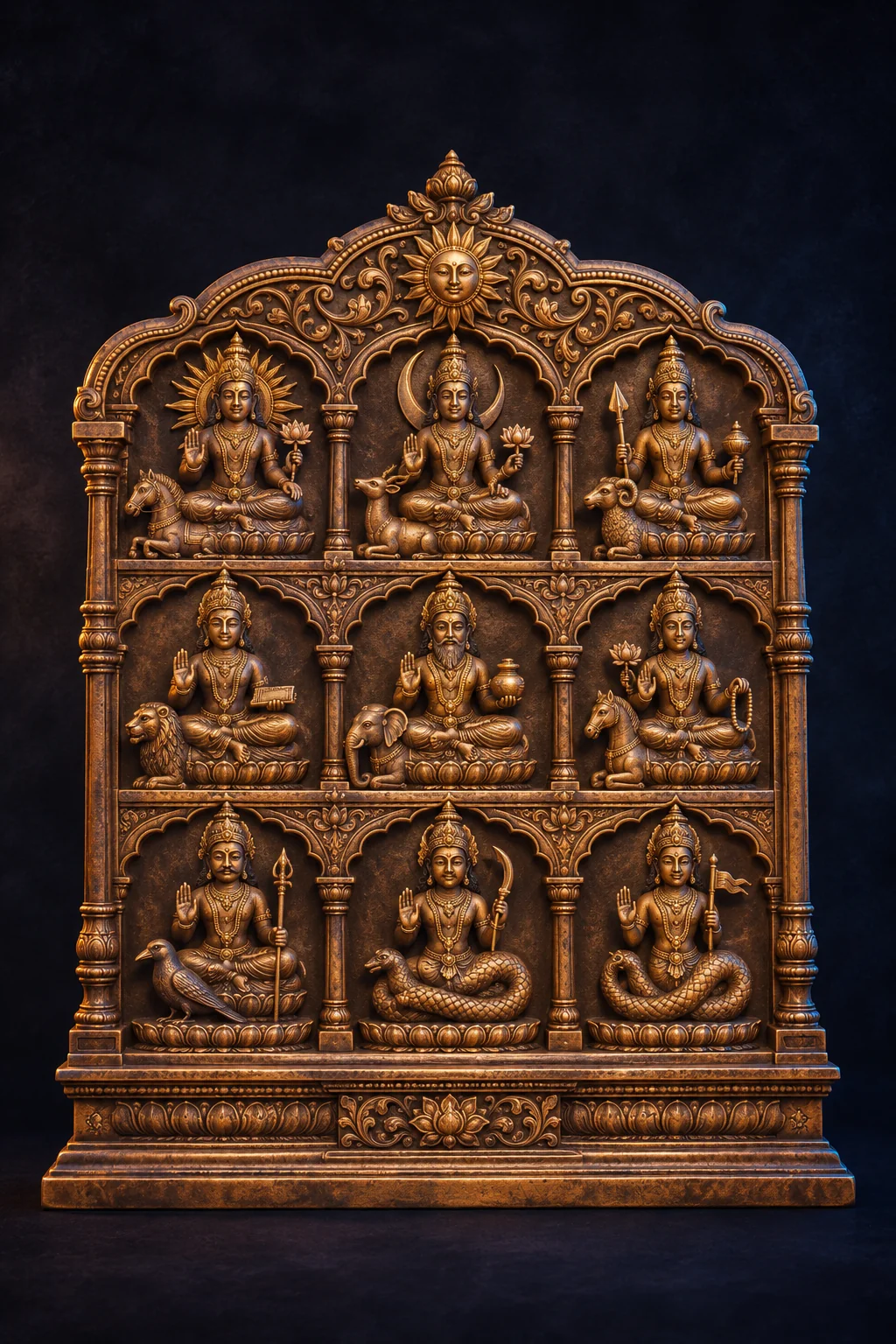
On LACMA’s c. 600–625 lintel and the Cleveland Museum of Art’s 700s relief, Jupiter is one of the seated or standing graha. Cleveland notes that Jupiter is nearly identical to the Moon, Mercury, Venus and Mars. Priestly attributes such as a book or rosary are not described in these two records.67
Sources
- Primary text in translation Translated by Kisari Mohan Ganguli, Mahabharata, Adi Parva (Sambhava Parva), Section LXXVI — SriPedia e-books (ibiblio) · Book 1, Sambhava Parva, section LXXVI: Usanas and Vrihaspati as priests; Kacha and Devayani · accessed 2026-11-03
- Primary text in translation Translated by Horace Hayman Wilson, Vishnu Purana, Book IV: Dynasty of the Moon, an account of Tara — Wisdom Library (online edition of the 1840 translation) · Book IV, lunar dynasty chapter: Soma, Tara, the Tarakamaya war and the birth of Budha (chapter numbering on the host page differs from some editions) · accessed 2026-11-03
- Primary text in translation Translated by Horace Hayman Wilson, Vishnu Purana, Book II, Chapter XII: Description of the Moon — Wisdom Library (online edition of the 1840 translation) · Book II, ch. XII: chariots of the Moon and of the planets; cords binding them to Dhruva · accessed 2026-11-03
- Classical Jyotisha text in modern translation Translated by R. Santhanam, Brihat Parasara Hora Sastra, Chapter 3: Planetary Characters and Description — Ranjan Publications (digitised volume 1, Internet Archive) · Vol. 1, ch. 3, approx. vv. 11–30 (verse labels in the digitised text are partly illegible) · accessed 2026-11-03
Researched 2026-11-08 from the cited sources. Community corrections are welcome; traditions differ, and differences are shown rather than resolved.