Names
- Budha — Mercury, ruler of Wednesday1
A disputed birth
The Vishnu Purana tells Budha’s origin in its lunar-dynasty chapter. Soma, the Moon, carried off Tara, the wife of Brihaspati, the preceptor of the gods. Ushanas (Shukra) sided with Soma out of enmity to Brihaspati, Rudra supported Brihaspati, and the conflict became the Tarakamaya war.2
Brahma compelled Soma to return Tara, but she was pregnant. When the child was born, both Brihaspati and Soma claimed him. Asked whose child he was, Tara answered, blushing, “Of Soma,” and the child was named Budha.2
The story makes Mercury the child of a rupture between the Moon and the teacher of the gods, so the planet’s ancestry runs through both the luminaries and the priestly world. The chapter does not frame this as a simple moral tale. It explains a genealogy, and the conflict has to be resolved before the dynasty can continue.2
Ancestor of the lunar kings
The Vishnu Purana goes on to say that Budha begot Pururavas by Ila, carrying the line of the Moon into the Chandravamsha, the lunar dynasty of kings. Royal genealogies of this kind tie the planetary family to human history as the Puranas tell it.2
A chariot of air and fire
The Vishnu Purana’s planetary chapter says Mercury’s chariot is made of the elements air and fire and drawn by eight bay horses as swift as the wind. The detail fits Mercury, the fastest-moving of the visible planets, though the Purana itself does not draw the astronomical comparison.3
Mercury in Jyotisha
Chapter 3 of the Brihat Parasara Hora Sastra, in Santhanam’s translation, gives Mercury the colour of green grass. It names Maha Vishnu as presiding deity and classes Mercury as neuter, alongside Saturn. The line giving Mercury’s main signification is not legible in the digitised translation consulted, so that signification is left unstated here.4
The neuter classification sits alongside the narratives, in which Budha is a son and a father of kings. As with the Moon, astrological categories and mythological persons are separate kinds of statement.42
Mercury in early sculpture
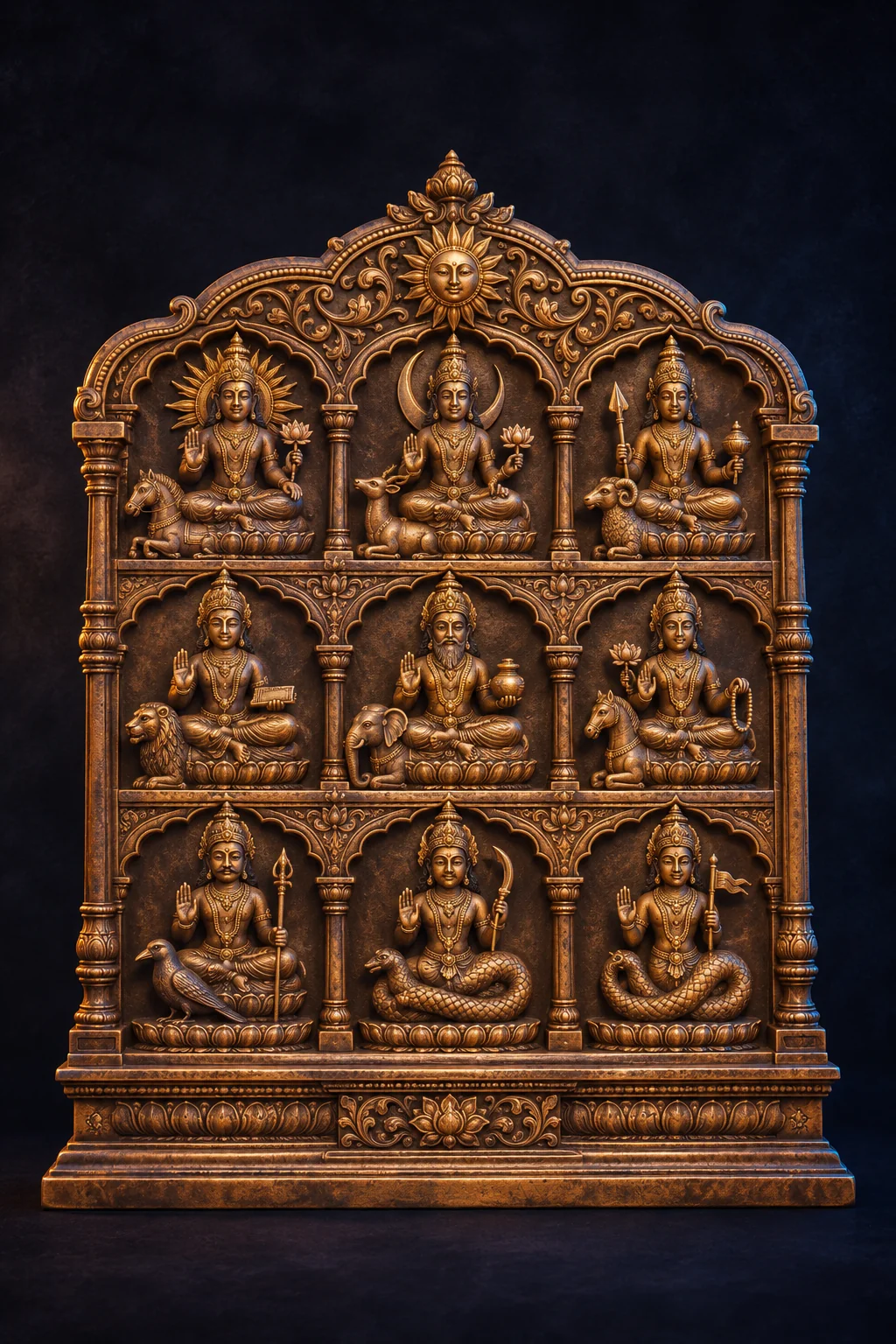
LACMA’s lintel (c. 600–625) and the Cleveland Museum of Art’s relief (700s) both include Mercury among the seated or standing planetary figures. Cleveland notes that its Moon, Mercury, Venus, Mars and Jupiter are nearly identical. In these early works Mercury is identified mainly by his position in the sequence, not by distinctive attributes.56
Sources
- Primary text in translation Translated by Horace Hayman Wilson, Vishnu Purana, Book IV: Dynasty of the Moon, an account of Tara — Wisdom Library (online edition of the 1840 translation) · Book IV, lunar dynasty chapter: Soma, Tara, the Tarakamaya war and the birth of Budha (chapter numbering on the host page differs from some editions) · accessed 2026-11-03
- Primary text in translation Translated by Horace Hayman Wilson, Vishnu Purana, Book II, Chapter XII: Description of the Moon — Wisdom Library (online edition of the 1840 translation) · Book II, ch. XII: chariots of the Moon and of the planets; cords binding them to Dhruva · accessed 2026-11-03
- Classical Jyotisha text in modern translation Translated by R. Santhanam, Brihat Parasara Hora Sastra, Chapter 3: Planetary Characters and Description — Ranjan Publications (digitised volume 1, Internet Archive) · Vol. 1, ch. 3, approx. vv. 11–30 (verse labels in the digitised text are partly illegible) · accessed 2026-11-03
Researched 2026-11-08 from the cited sources. Community corrections are welcome; traditions differ, and differences are shown rather than resolved.