Names
- Chandra — the Moon, ruler of Monday. Arose from the ocean of milk, in the Navagraha hymn.1
Soma, the Moon
In Puranic and epic narratives the Moon is usually called Soma. The Vishnu Purana’s lunar-dynasty chapter calls Soma the son of the sage Atri and founder of a royal line. The same chapter tells how his success made him arrogant, a turn the rest of his story depends on.2
Why the Moon waxes and wanes: the gods drink
The Vishnu Purana explains the lunar phases through ritual drinking. Its Moon rides a three-wheeled chariot drawn by ten horses white as jasmine. As the Moon wanes, the gods drink the nectar stored in him until only one kala, or digit, is left. The Sun then restores him with a single ray, and the ancestors, the pitris, come in the afternoon to drink the last portion.3
Why the Moon waxes and wanes: Daksha’s curse
The Mahabharata’s Shalya Parva tells a different story. Daksha gave his twenty-seven daughters in marriage to Soma, but Soma delighted only in Rohini, the most beautiful. The neglected wives complained to their father, and the angry Daksha struck Soma with a wasting disease.4
Daksha told Soma to bathe where the Sarasvati meets the ocean. Bathing there on the day of the new moon, the Moon regained his cool rays, but Daksha’s decree remained: Soma would wane for half of every month and wax for the other half. The episode ties the lunar cycle to a sacred bathing place on the river.4
Tara and the birth of Budha
The Vishnu Purana says that after his royal sacrifice Soma carried off Tara, wife of Brihaspati, the gods’ preceptor. Ushanas (Shukra), out of enmity to Brihaspati, sided with Soma, while Rudra supported Brihaspati. The resulting conflict became known as the Tarakamaya war.2
Brahma intervened and compelled Soma to return Tara. When she bore a son, both claimed him, and Tara finally answered, blushing, “Of Soma.” The child was Budha, the planet Mercury. Through Budha’s son Pururavas the narrative founds the lunar dynasty of kings.2
Eclipse and image
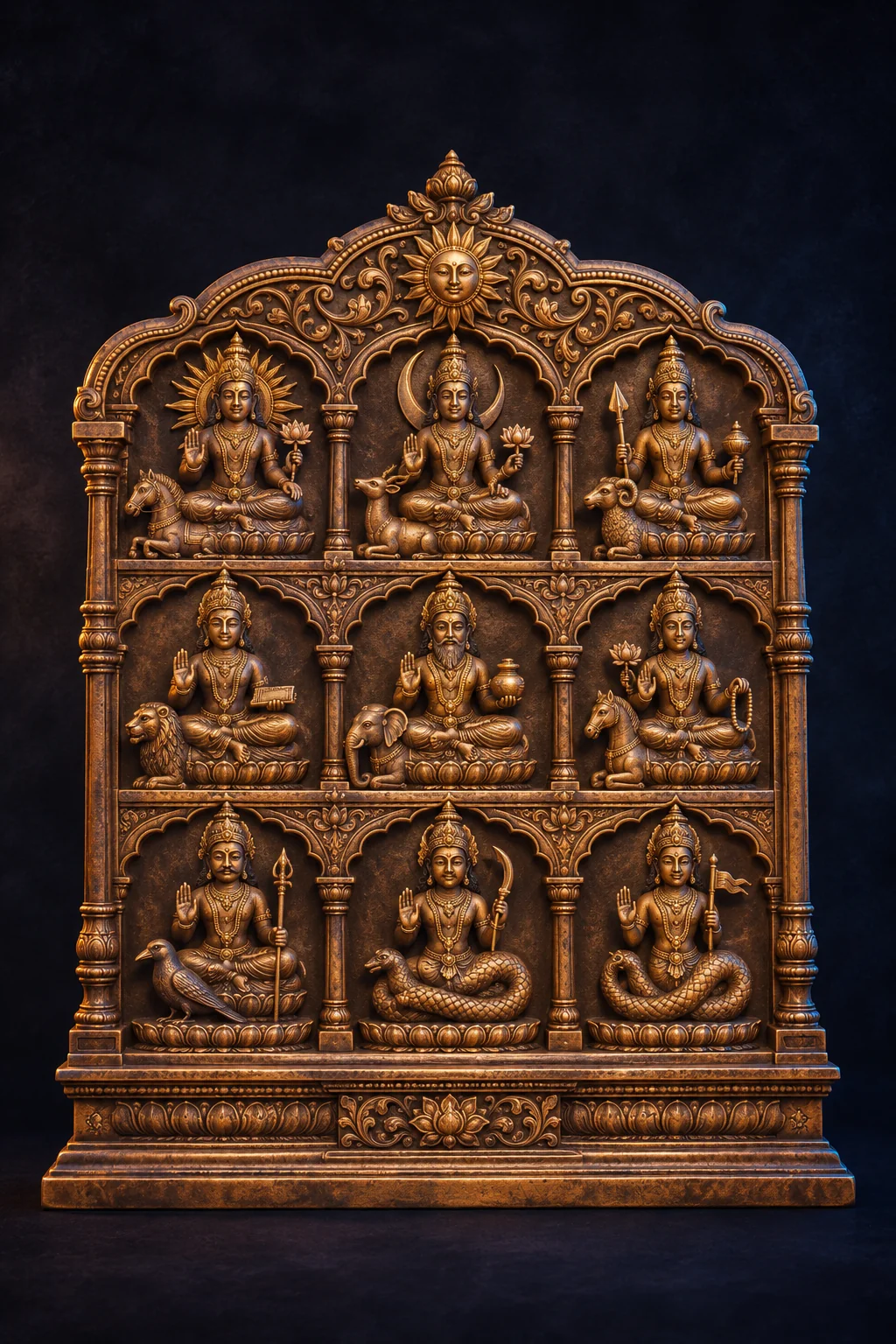
Soma is one of the two luminaries who exposed Rahu at the churning of the ocean. The Mahabharata says Rahu’s head still swallows the Sun and Moon in revenge, which is how it explains eclipses. On LACMA’s seventh-century lintel the Moon is told apart from the other seated graha by his curly hair, where they have the piled hair of ascetics. He holds a water vessel in his left hand.56
Chandra in Jyotisha
Santhanam’s translation of the Brihat Parasara Hora Sastra calls the Moon the mind. It describes the Moon as tawny, with Varuna as presiding deity, and classes the Moon as female. That classification differs from the narratives above, where Soma is a male god and husband. The difference shows that astrological categories and mythological persons are separate kinds of statement, even when they share a name.7
Sources
- Primary text in translation Translated by Horace Hayman Wilson, Vishnu Purana, Book IV: Dynasty of the Moon, an account of Tara — Wisdom Library (online edition of the 1840 translation) · Book IV, lunar dynasty chapter: Soma, Tara, the Tarakamaya war and the birth of Budha (chapter numbering on the host page differs from some editions) · accessed 2026-11-03
- Primary text in translation Translated by Horace Hayman Wilson, Vishnu Purana, Book II, Chapter XII: Description of the Moon — Wisdom Library (online edition of the 1840 translation) · Book II, ch. XII: chariots of the Moon and of the planets; cords binding them to Dhruva · accessed 2026-11-03
- Primary text in translation Translated by Kisari Mohan Ganguli, Mahabharata, Shalya Parva, Section XXXV — SriPedia e-books (ibiblio) · Book 9, section XXXV: Daksha’s daughters, Rohini, the curse and Prabhasa · accessed 2026-11-03
- Primary text in translation Translated by Kisari Mohan Ganguli, Mahabharata, Adi Parva (Astika Parva), Section XIX — SriPedia e-books (ibiblio) · Book 1, Astika Parva, section XIX: Rahu drinks the amrita and is beheaded · accessed 2026-11-03
- Classical Jyotisha text in modern translation Translated by R. Santhanam, Brihat Parasara Hora Sastra, Chapter 3: Planetary Characters and Description — Ranjan Publications (digitised volume 1, Internet Archive) · Vol. 1, ch. 3, approx. vv. 11–30 (verse labels in the digitised text are partly illegible) · accessed 2026-11-03
Researched 2026-11-08 from the cited sources. Community corrections are welcome; traditions differ, and differences are shown rather than resolved.