Names
- Ketu — the descending lunar node1
A graha with several identities
Ketu is the least settled of the nine in the sources gathered for this edition. Early museum objects identify Ketu as the personification of comets. Santhanam’s translation of the Brihat Parasara Hora Sastra treats Ketu as the Moon’s second node, opposite Rahu. The Mahabharata’s account of Rahu’s beheading does not name Ketu at all.234
Popular retellings often say that Ketu is the body of Rahu, the trunk left behind when Rahu’s head was cut off. The Mahabharata passage consulted here describes that trunk falling and shaking the earth but does not call it Ketu. The source that first makes this identification is still to be documented.4
The comet in early sculpture
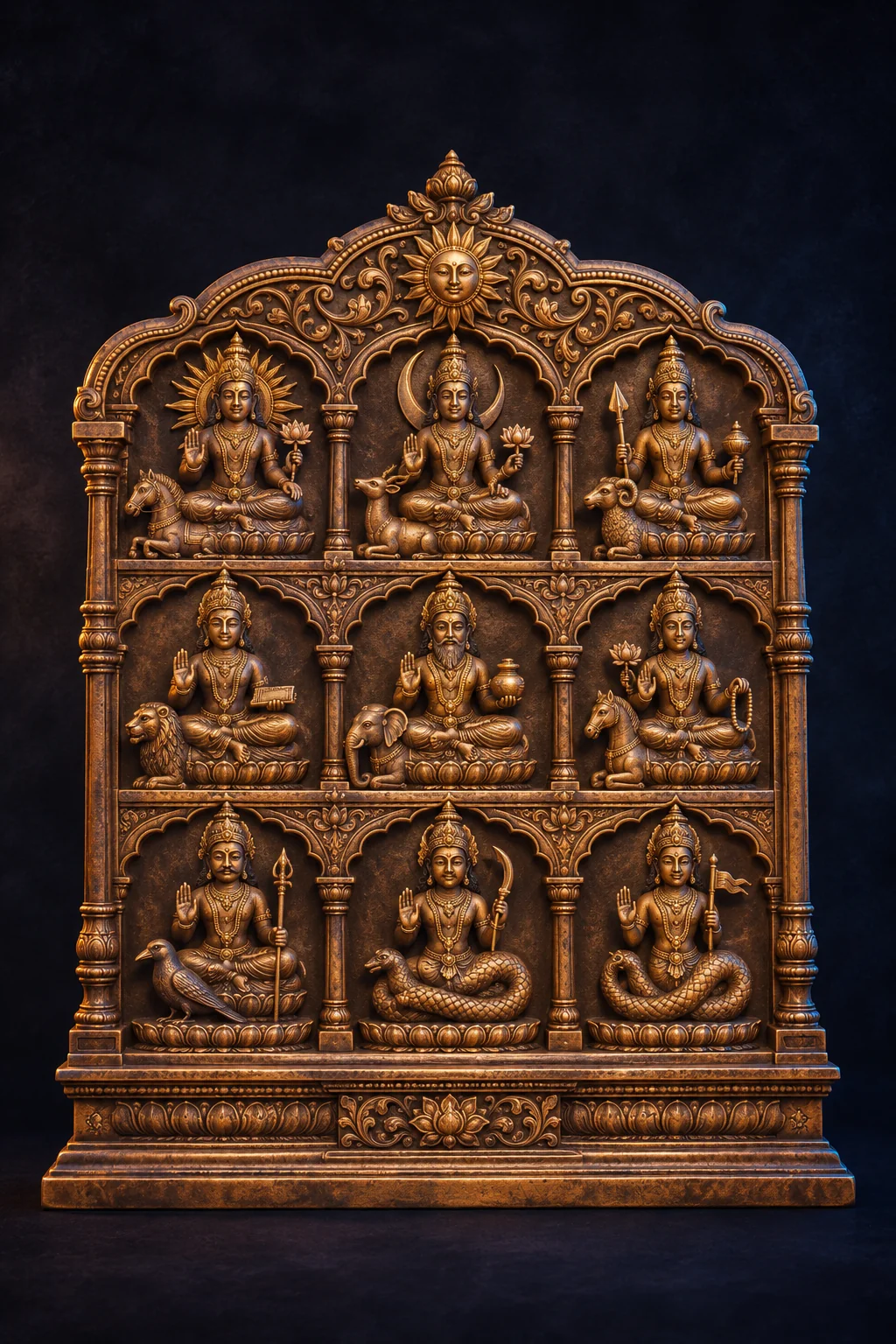
On LACMA’s lintel from Uttar Pradesh (c. 600–625) Ketu is a half-serpentine figure who appears female and wears an ascetic’s hairstyle. She holds a sword or club in the left hand and raises the right in a gesture of reassurance. The museum describes this figure as the personification of comets.2
The Cleveland Museum of Art’s Central Indian relief of the 700s ends its row of celestial bodies with a comet shown as a serpent-tailed figure. The serpent body in both objects suggests a shared early way of showing Ketu, though two objects cannot establish a universal rule.5
Ketu’s chariot
The Vishnu Purana’s planetary chapter gives Ketu a chariot drawn by eight horses the dusky red of lac, or of the smoke of burning straw. It pairs this with Rahu’s eight black horses. The two shadow grahas are described as a matched pair with contrasting colours.6
The same chapter fastens all nine planetary chariots, Ketu’s among them, to Dhruva, the pole star, by cords of air. Ketu is part of the ordered Puranic sky like the other eight, whatever his origin.6
Ketu in Jyotisha
Chapter 3 of the Brihat Parasara Hora Sastra, in Santhanam’s translation, says Ketu is similar to Rahu, who is described as smoky in appearance, fearsome and windy in temperament. Both are classed as malefics. The translator’s notes explain the pair as shadowy nodes of the Moon 180 degrees apart. That gives Ketu a precise astronomical position, though it has no visible body.3
The node interpretation and the comet personification are not necessarily contradictory: both describe Ketu as a celestial power without a solid planetary body. They do, however, describe different phenomena, and GOD VERSE keeps them separate instead of choosing one.32
Sources
- Classical Jyotisha text in modern translation Translated by R. Santhanam, Brihat Parasara Hora Sastra, Chapter 3: Planetary Characters and Description — Ranjan Publications (digitised volume 1, Internet Archive) · Vol. 1, ch. 3, approx. vv. 11–30 (verse labels in the digitised text are partly illegible) · accessed 2026-11-03
- Primary text in translation Translated by Kisari Mohan Ganguli, Mahabharata, Adi Parva (Astika Parva), Section XIX — SriPedia e-books (ibiblio) · Book 1, Astika Parva, section XIX: Rahu drinks the amrita and is beheaded · accessed 2026-11-03
- Primary text in translation Translated by Horace Hayman Wilson, Vishnu Purana, Book II, Chapter XII: Description of the Moon — Wisdom Library (online edition of the 1840 translation) · Book II, ch. XII: chariots of the Moon and of the planets; cords binding them to Dhruva · accessed 2026-11-03
Researched 2026-11-08 from the cited sources. Community corrections are welcome; traditions differ, and differences are shown rather than resolved.