Names
- Mangala — Mars, ruler of Tuesday. Born of the earth, in the Navagraha hymn.1
Bhauma, the Earth’s son
The Vishnu Purana calls Mars Bhauma, a name formed from bhumi, the Earth, and gives him a splendid golden car of octagonal shape drawn by eight horses. The name places the planet in a family: whatever else is said about him, Mangala is a child of the Earth.2
Madhya Pradesh Tourism’s account of the Mangalnath temple says that, according to the Matsya Purana, Mangal is the son of Prithvi, the Earth. The same page also reports a tradition that Mars arose from a drop of Shiva’s sweat during a cosmic battle. These are two origin accounts, and the second does not simply replace the first.3
Mangalnath, Ujjain
Mangalnath stands on the bank of the Shipra river in Ujjain, Madhya Pradesh. The state tourism board says it is believed to mark the birthplace of Mars. Shiva is the presiding deity, and devotees come for rites associated with the planet. Tuesdays, the day of Mangal, draw large crowds.3
The same page notes that Ujjain was historically regarded as a prime meridian for time calculation and that its clear skies made the site good for observing Mars. These are claims from a state tourism body. They are worth further corroboration from historians of Indian astronomy and are recorded here with that attribution.3
Mars in Jyotisha
Chapter 3 of the Brihat Parasara Hora Sastra, in Santhanam’s translation, associates Mars with strength. It gives the planet a blood-red colour, the same as the Sun’s, and names Subrahmanya, the war god also called Skanda or Kartikeya, as presiding deity. Mars is classed as male.4
The text states these associations without explaining them. GOD VERSE records them as one text’s significations, not as predictions about individual lives, and leaves interpretations that link them to the planet’s red light to sources that argue for them.4
Mars in early sculpture
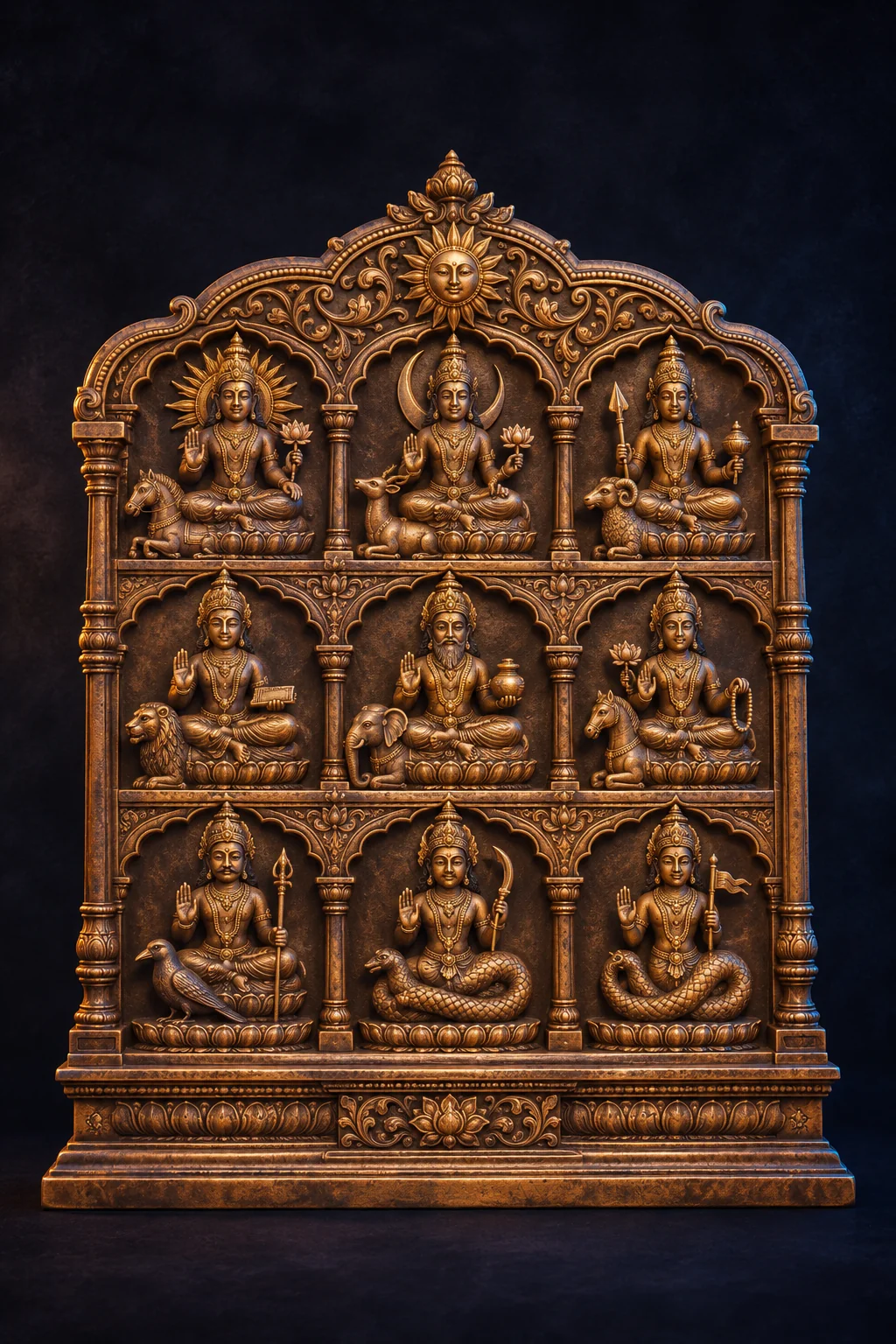
Mars is hard to pick out in the earliest Navagraha rows. On LACMA’s lintel (c. 600–625) he is one of six seated figures, four of whom share a gesture of reassurance and hold water vessels. The Cleveland Museum of Art says the Moon, Mercury, Venus, Mars and Jupiter on its 700s relief are nearly identical. Individual attributes, such as a mount, belong to later or regional conventions that this entry has not yet documented.56
This is a useful caution for anyone matching a temple carving to a horoscope: in some early works Mars has no distinctive attribute, and identifying him depends on his position in the row.6
Scope of this entry
This entry draws on the Vishnu Purana in translation, a state tourism account, one Jyotisha text and two museum records. It does not yet document Tamil temple traditions, primary Puranic chapters on Mars’s birth, or practices relating to Mars in marriage compatibility. Those need source-specific research before publication.234
Sources
- Primary text in translation Translated by Horace Hayman Wilson, Vishnu Purana, Book II, Chapter XII: Description of the Moon — Wisdom Library (online edition of the 1840 translation) · Book II, ch. XII: chariots of the Moon and of the planets; cords binding them to Dhruva · accessed 2026-11-03
- State tourism interpretation Madhya Pradesh Tourism, Mangalnath Temple, Ujjain — Madhya Pradesh Tourism Board · Temple description; Matsya Purana attribution; Tuesday visits · accessed 2026-11-03
- Classical Jyotisha text in modern translation Translated by R. Santhanam, Brihat Parasara Hora Sastra, Chapter 3: Planetary Characters and Description — Ranjan Publications (digitised volume 1, Internet Archive) · Vol. 1, ch. 3, approx. vv. 11–30 (verse labels in the digitised text are partly illegible) · accessed 2026-11-03
Researched 2026-11-08 from the cited sources. Community corrections are welcome; traditions differ, and differences are shown rather than resolved.