
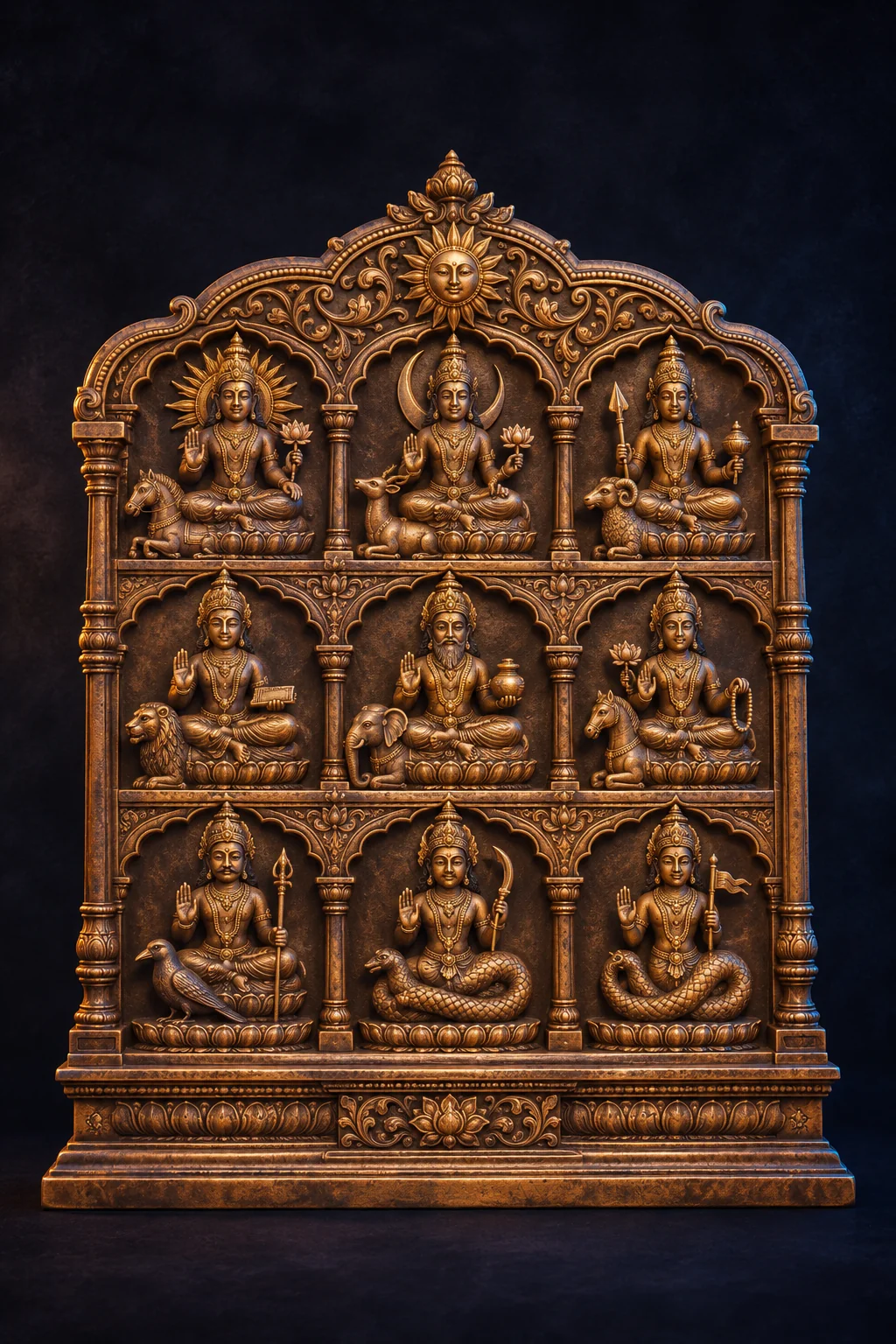
Names
- Shani — Saturn, ruler of Saturday. Son of Ravi, the Sun, born of Chhaya.1
Son of the Sun and the Shadow
The Vishnu Purana says that Sanjna, the Sun’s wife, could not endure his heat and left Chhaya, her shadow, in her place. Taking Chhaya for Sanjna, the Sun fathered three children by her: Shanaishchara, the planet Saturn; Savarni, a future Manu; and a daughter, Tapati. Shani is thus the Sun’s son, born to a substitute wife who was a shadow.2
The story explains Shani’s position in the planetary family. He belongs to the house of the brightest graha, yet his mother is a shadow and his birth comes from a deception. The Purana itself simply records the genealogy and draws no moral from it.2
The slow mover
The Vishnu Purana describes the tardy-paced Shani moving slowly along in a car drawn by piebald horses. The description matches Saturn’s slow apparent motion against the stars, the slowest of the planets visible to the naked eye.3
The Cleveland Museum of Art’s Central Indian relief of the 700s gives a sculptural explanation of the same trait. Its Saturn stands on one leg, which the museum says is because a goddess wounded him to stop him moving swiftly, and the museum calls him a portent of doom. On LACMA’s c. 600–625 lintel Saturn is the only one of the six seated planetary figures who does not hold a water vessel.45
Saturn in Jyotisha
Chapter 3 of the Brihat Parasara Hora Sastra, in Santhanam’s translation, says Saturn denotes grief. It describes him as dark, with Brahma as presiding deity, and classes him as neuter, alongside Mercury. Much of Saturn’s reputation in popular astrology as a graha of hardship and testing builds on classical significations of this kind.6
Tirunallar and the trial of Nala
At the Darbaranyeswarar temple at Tirunallar, near Karaikal in the Union Territory of Puducherry, Shiva is the presiding deity and Sani is a major focus of devotion. The TN Temples Project records the local tradition: Sani tested King Nala, who lost his kingdom, wealth and wife. When Nala worshipped at this shrine, Sani was afraid to enter and released him, at Nala’s request remaining at the threshold to bless devotees.7
The same record notes the common belief that Sani enters a person’s life three times for about seven and a half years each, as a test. The temple tradition gives the Nala story a specific place.7
Two tellings of Nala’s trouble
The Mahabharata’s own Nala episode, in the Vana Parva, names a different afflicting power. There Kali, the personified age of strife, waits twelve years for a ritual lapse. He enters Nala when the king says his twilight prayers without first washing his feet. The temple tradition’s Sani and the epic’s Kali are two attributions of Nala’s misfortune, and GOD VERSE records both without merging them.87
Sources
- Primary text in translation Translated by Horace Hayman Wilson, Vishnu Purana, Book III, Chapter II: Of the seven future Manus — Wisdom Library (online edition of the 1840 translation) · Book III, ch. II: Sanjna, Chhaya, the children of Chhaya; Vishvakarman trims the Sun · accessed 2026-11-03
- Primary text in translation Translated by Horace Hayman Wilson, Vishnu Purana, Book II, Chapter XII: Description of the Moon — Wisdom Library (online edition of the 1840 translation) · Book II, ch. XII: chariots of the Moon and of the planets; cords binding them to Dhruva · accessed 2026-11-03
- Classical Jyotisha text in modern translation Translated by R. Santhanam, Brihat Parasara Hora Sastra, Chapter 3: Planetary Characters and Description — Ranjan Publications (digitised volume 1, Internet Archive) · Vol. 1, ch. 3, approx. vv. 11–30 (verse labels in the digitised text are partly illegible) · accessed 2026-11-03
- Independent temple documentation Aniruddh, TN Temples Project, Darbaranyeswarar, Tirunallar, Karaikal — TN Temples Project · Temple record; Sani and the Nala story · accessed 2026-11-03
- Primary text in translation Translated by Kisari Mohan Ganguli, Mahabharata, Vana Parva (Nalopakhyana Parva), Section LIX — SriPedia e-books (ibiblio) · Book 3, section LIX: Kali waits twelve years and enters Nala · accessed 2026-11-03
Researched 2026-11-08 from the cited sources. Community corrections are welcome; traditions differ, and differences are shown rather than resolved.