
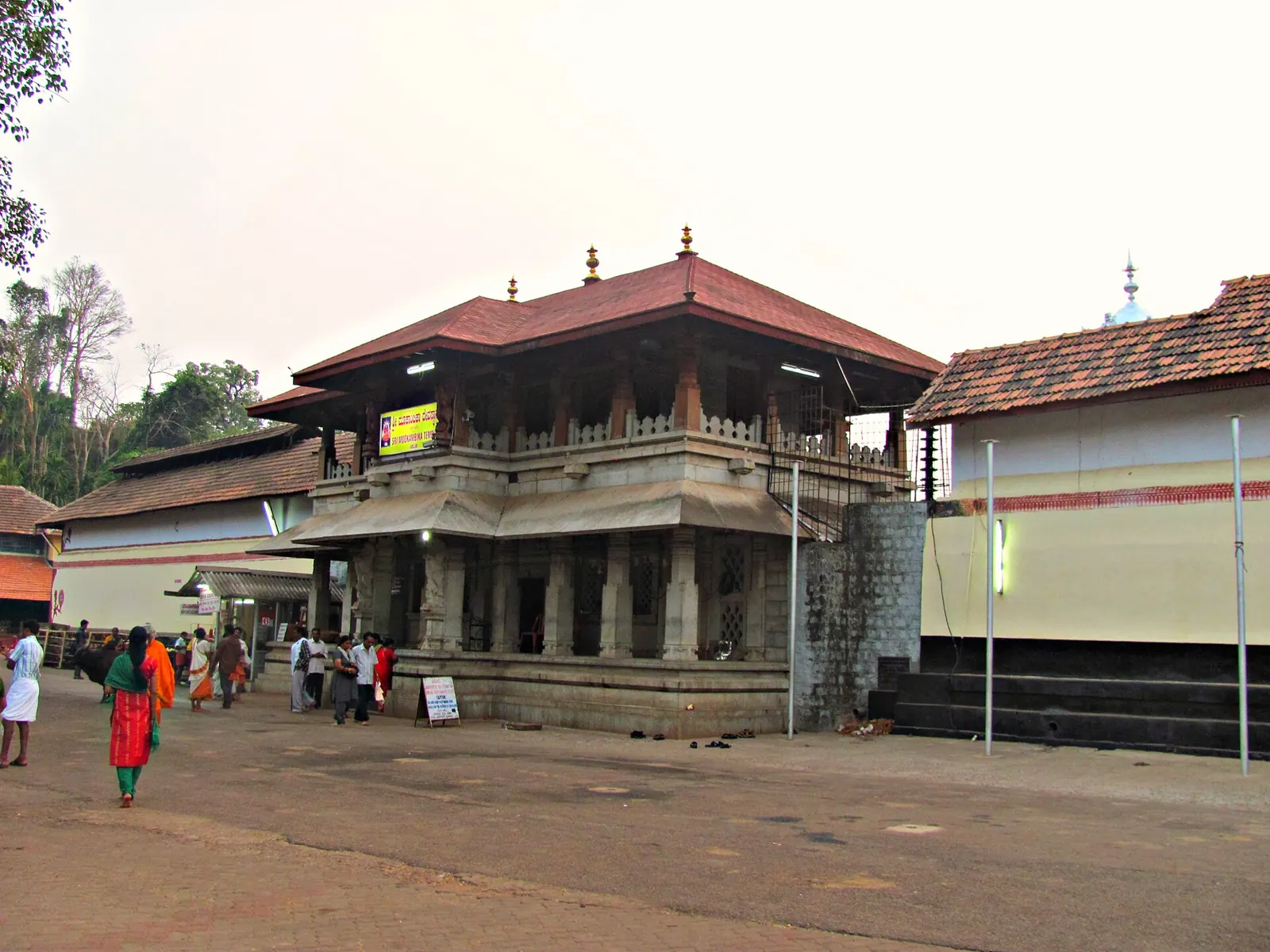
Legend sthala purana · as told by tradition
The demon Kaumasura did penance to win invincibility from Shiva, but was struck mute before he could ask for the boon and became Mookasura, the mute demon. The goddess Mookambika, formed from the combined powers of the Trimurti and Tridevi, killed him at the spot now called Marana Katte, and settled at Kollur.1
Another tradition says Adi Shankara wished to take the goddess to Kerala; she agreed to follow if he never looked back, and when he turned she stayed at Kollur, which is why devotees link Mookambika with Chottanikkara.1
Documented history
Tradition says Adi Shankara came to Kollur in the eighth century, meditated near Kodachadri, and installed the goddess on a Sri Chakra pedestal with a jyotirlinga before her, a gold line dividing it into Shakti on the left and Shiva on the right.12
Local rulers, especially the Keladi dynasty, paid for much of the construction and expansion; the temple mixes Dravidian, Vijayanagara and Hoysala styles under a gold-plated crest and copper roof. Navaratri in Ashwina and a chariot festival in Phalguna are its great festivals, and children begin their letters (Vidyarambham) in the Saraswati Mandapa.12
Where sources differ
Karnataka Tourism says Saraswati struck the demon mute; the encyclopedia account says Shakti did. The encyclopedia names a King Halugallu Veera Sangayya as builder about 800 CE, without a source; the tourism department credits the Keladi rulers with much of the building.12
Where to go next
 AI-created illustration
 AI-created illustration
Sources
- Government Sri Mookambika Temple — Karnataka Tourism, Government of Karnataka · accessed 2026-11-08
- Encyclopedia Kollur Mookambika Temple — Wikipedia · accessed 2026-11-08
Researched 2026-11-08 from the cited sources. Community corrections are welcome; traditions differ, and differences are shown rather than resolved.