Names
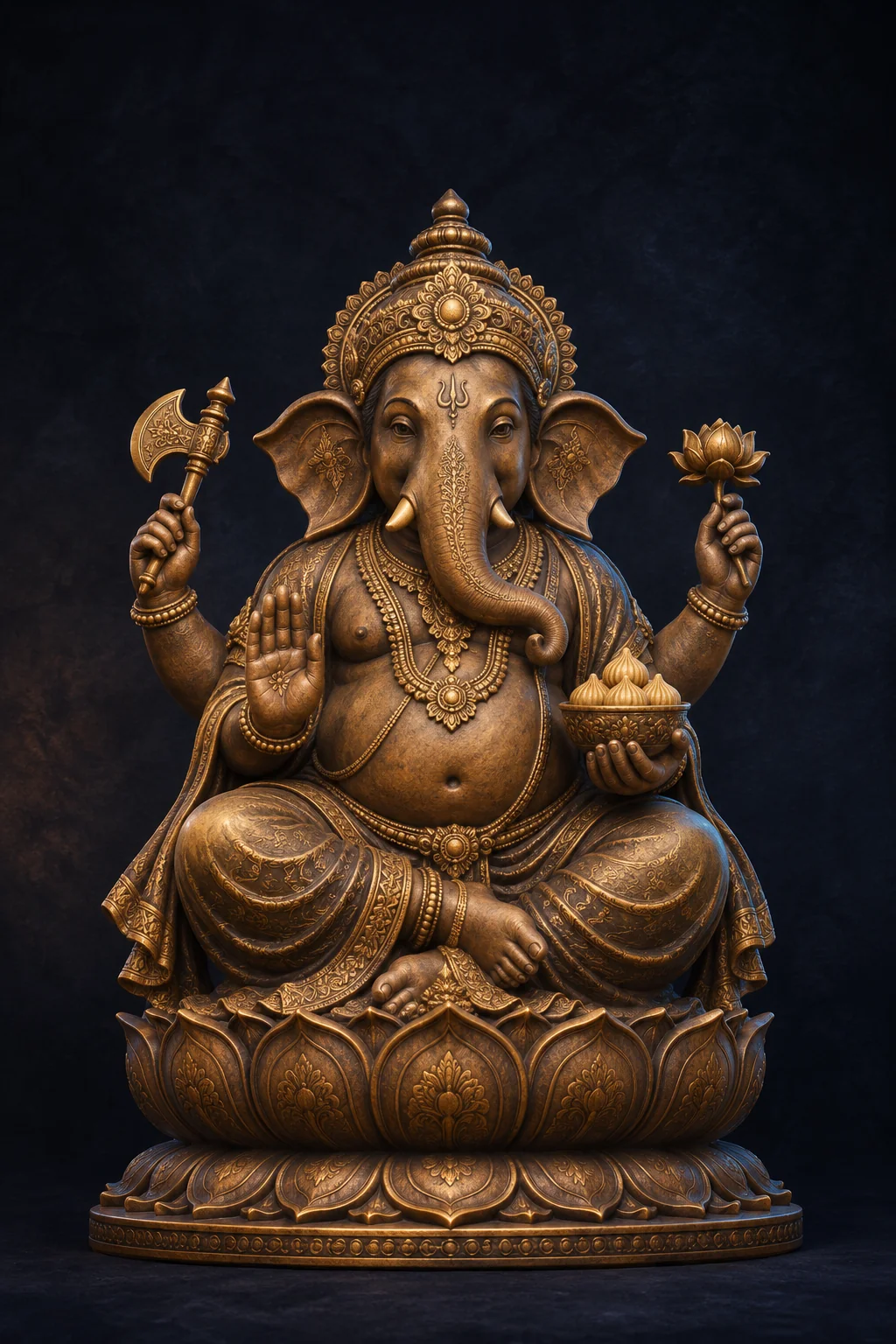
- Ganesha — lord (isha) of the ganas, the hosts1
- Ganapati — ruler of the hosts1
- Vinayaka — a common name in the Puranas and Buddhist Tantras1
- Vighneshvara — Lord of Obstacles1
- Pillaiyar — noble child (Tamil)1
- Ekadanta — he of one tusk1
- Lambodara — pot-bellied1
- Gajanana — elephant-faced1
- Dvaimatura — he who has two mothers1
Family
- Siblings
- Kartikeya (Subrahmanya)
Traditions differ on his marriage: many link him with Buddhi, Siddhi and Riddhi; others, common in South India, hold him an unmarried brahmachari.1
History
Ganesha is mentioned in texts from the first century BCE to the second century CE; his classic form appears in the fourth to fifth centuries CE, and an independent cult was well established by about the tenth century.1
His mount is the mouse or shrew Mushaka, and he usually holds his broken tusk.1
Devotional identity
The Kimbell Art Museum identifies its four-armed sculpture as Ganesha and describes widespread devotion to him as a remover of obstacles and bestower of good fortune. These are religious associations, not promises of a guaranteed practical result.2
An early surviving image
The Kimbell dates this terracotta relief to the fifth–sixth century CE. That is the date of this particular artwork, not a claim that Ganesha worship began at exactly that time.2
One account of the elephant head
The Kimbell recounts a legend in which Parvati creates a guardian who refuses Shiva entry. Shiva beheads him and subsequently replaces his head with an elephant’s to appease Parvati. This is an attributed narrative, not a claim that every text or community tells the origin in precisely this way.2
Regional context
The Met describes temple niches in Odisha that place Ganesha alongside Shiva, Parvati and Skanda. A regional sculptural programme is evidence for that context, rather than a single template for all temples.3
How traditions differ
Ganapatya
Ganesha is the Supreme Being.1
Birth accounts
In one account Parvati shapes him from clay to guard her and Shiva gives him an elephant’s head after beheading him; in another he is born of Shiva’s laughter; a third has him born of the elephant-headed goddess Malini.1
Where to go next
 AI-created illustrationRavana and the AtmalingaHow Shiva’s own linga came to rest at Gokarna, and why Murudeshwar is part of the same story.
- AI-created illustrationHow Ganesha got his elephant headSeveral tellings of the birth of the elephant-headed god.
 AI-created illustrationSankashti ChaturthiThe monthly fast for Ganesha, broken at moonrise.
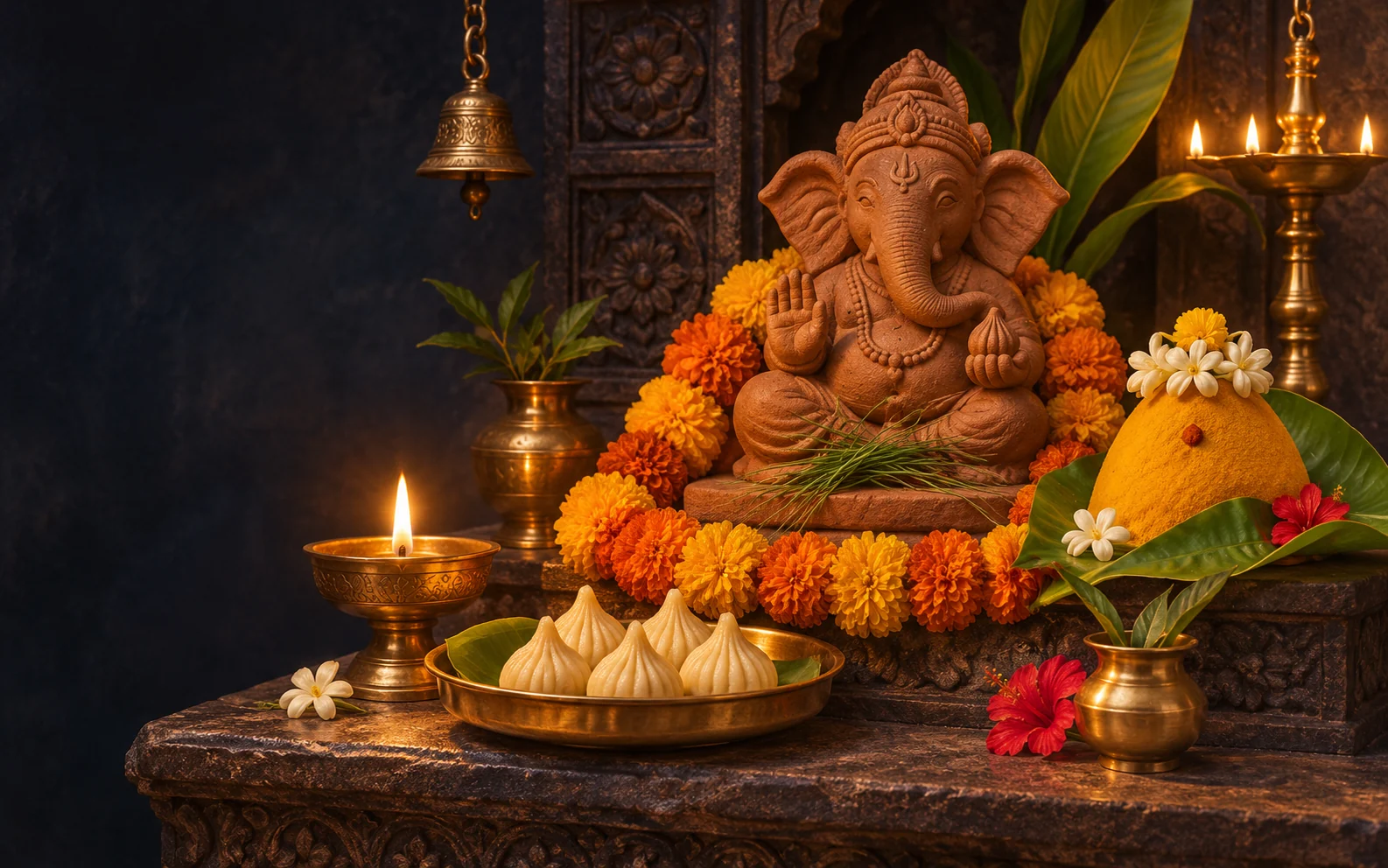 AI-created illustrationGanesh Chaturthi (with Gowri Habba)The birthday festival of Ganesha, preceded in Karnataka by the Gowri festival.
Sources
- Encyclopedia Ganesha — Wikipedia · accessed 2026-11-08
- Collection record Kimbell Art Museum, Four-Armed Ganesha — Kimbell Art Museum · Collection AP 1981.11 · accessed 2026-11-02
- Museum scholarly essay Vidya Dehejia, Hinduism and Hindu Art — The Metropolitan Museum of Art · Religion, iconography and temple sections · accessed 2026-11-02
Researched 2026-11-08 from the cited sources. Community corrections are welcome; traditions differ, and differences are shown rather than resolved.