
Legend sthala purana · as told by tradition
Ravana won the Atmalinga from Shiva on condition that it not touch the ground before Lanka. Vishnu brought on a false dusk near Gokarna; as Ravana stopped for his evening rites, Ganesha as a Brahmin boy held the linga and set it down after calling three times. Ravana could not lift it again, and it became Mahabaleshwara, the all-powerful lord.12
Fragments from Ravana’s struggle are said to have become the Panchalinga shrines along the coast, Murudeshwar among them; the town’s name is read as “cow’s ear”, for the shape of the land.13
Documented history
The temple is described as of the fourth century CE, built over an existing linga by the Kadamba king Mayuravarma, and Kalidasa’s Raghuvamsha mentions the “Lord of Gokarna”.2
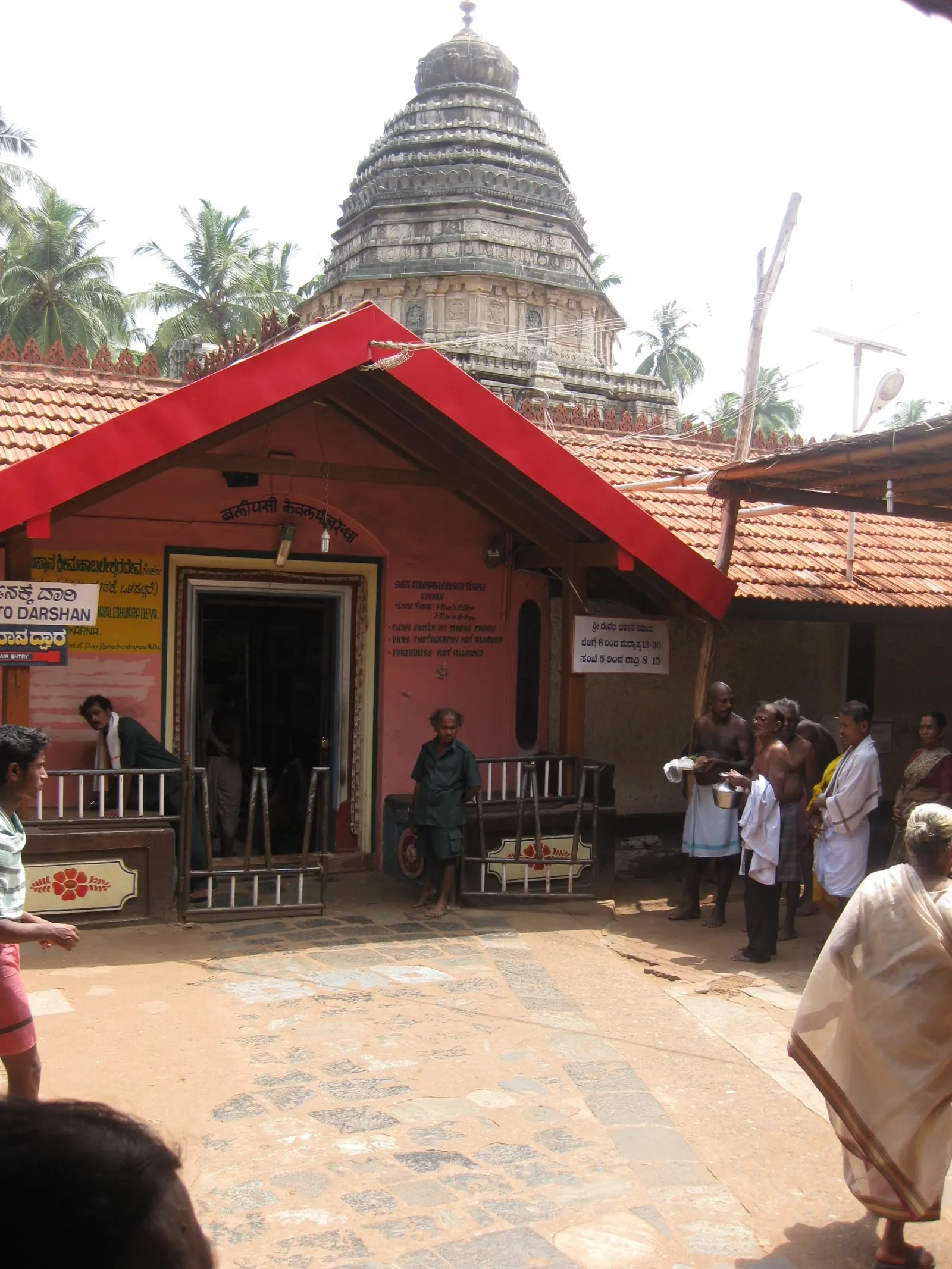
The Kanara Gazetteer (1883) describes a granite Dravidian temple with a shrine 30 feet square and 60 feet high, its domed roof carved with serpents, the guardians of the eight directions and the ten avatars of Vishnu; the copper spire and outer hall were said to be later additions by a Tulu Brahmin of Kundapur. The great Maha Shivaratri fair then filled the town every February.3
Devotees may enter the sanctum and touch the Atmalinga (sparsha darshan). The temple is now administered by an Overseeing Committee appointed by the Supreme Court of India.1
Architecture
Where to go next
 AI-created illustration
 AI-created illustration
Sources
- Government Mahabaleshwar Temple, Gokarna — Karnataka Tourism, Government of Karnataka · accessed 2026-11-08
- Encyclopedia Mahabaleshwar Temple, Gokarna — Wikipedia · accessed 2026-11-08
- Book (1883) Gazetteer of the Bombay Presidency, Vol. XV, Part II: Kanara — Government Central Press, Bombay, 1883 · Internet Archive · Places: Gokarn (p. 289 ff.), Murdeshvar · accessed 2026-11-08
Researched 2026-11-08 from the cited sources. Community corrections are welcome; traditions differ, and differences are shown rather than resolved.