
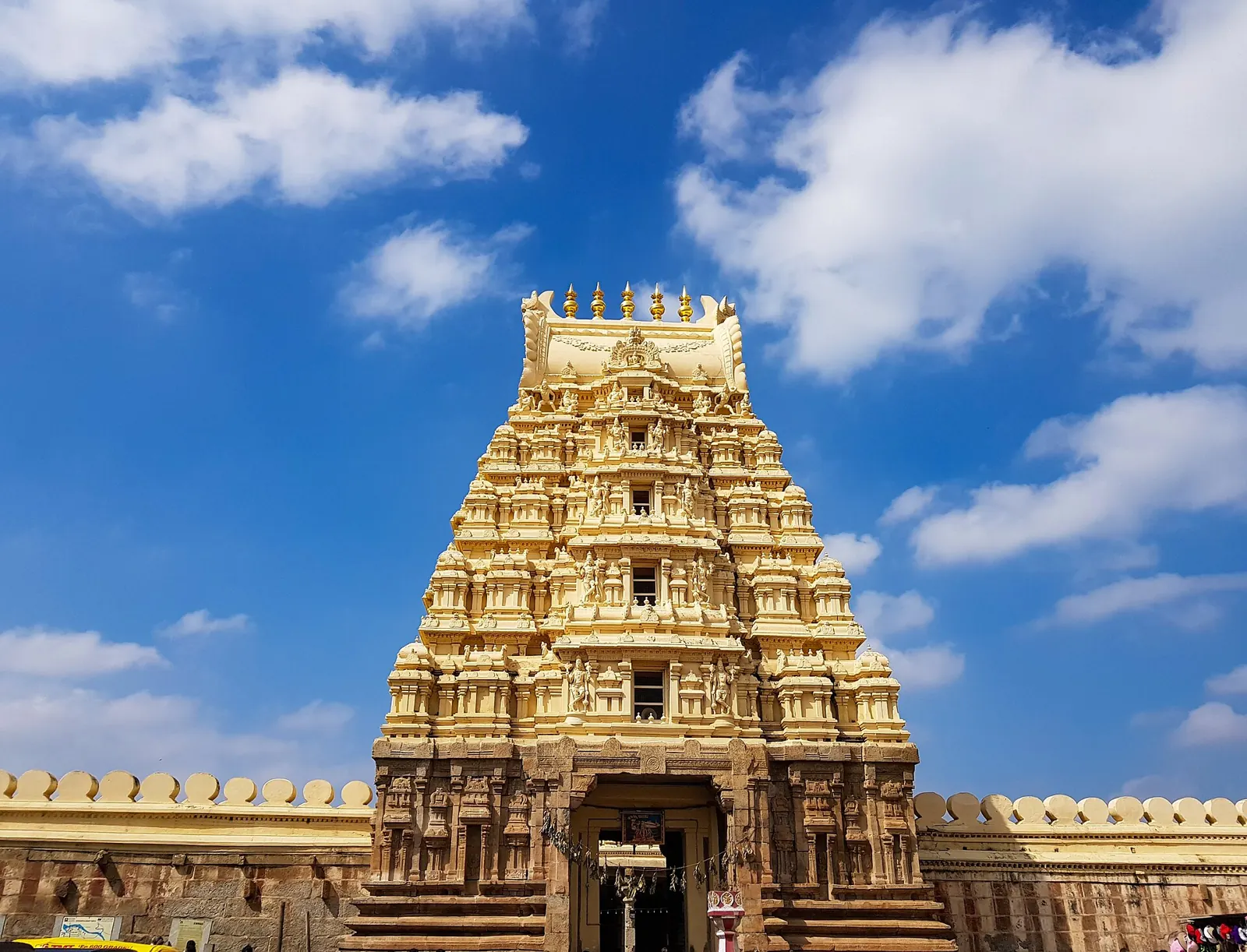
Legend sthala purana · as told by tradition
The sage Gautama is said to have worshipped Ranganatha and done penance here, at the “western Ranganatha kshetra” as distinct from Srirangam; a rock shelter on the small Gautama island upstream is called the rishi’s cave.3
Documented history
An inscription records that in 894, under the Ganga kings, one Tirumalaiya founded two temples on the then-jungled island, of Ranganatha and Tirumala Deva, walled them and named the place Sri-Ranga-pura.31
About 1117 Ramanujacharya, fleeing Chola persecution, won over the Hoysala king Vishnuvardhana, who granted him and his followers the Ashtagrama, the eight townships on both banks here. In 1454 Timmanna, a local governor, built a fort and enlarged the temple, Rice records, with materials from demolished Jain temples at Kalasvadi; Vijayanagara took direct control in 1495.31
The temples at Srirangapatna, Shivanasamudra and Srirangam are the Adi, Madhya and Antya Ranga, the Ranga of the beginning, middle and end.32
Architecture
Ranganatha reclines on the seven-hooded Adisesha with Lakshmi at his feet, within two great prakaras; festivals include the Bangarada Garudotsava, Sriranga Jayanti and Uyyalotsava.21
Sources
- Encyclopedia Ranganathaswamy Temple, Srirangapatna — Wikipedia · accessed 2026-11-08
- Government Ranganathaswamy Temple, Srirangapatna — Karnataka Tourism, Government of Karnataka · accessed 2026-11-08
- Book (1897) B. Lewis Rice, Mysore: A Gazetteer Compiled for Government, revised edition, Vol. II — Archibald Constable, Westminster, 1897 · Internet Archive · Mysore District: Chamundi hill, Seringapatam; Hassan District: Halebid · accessed 2026-11-08
Researched 2026-11-08 from the cited sources. Community corrections are welcome; traditions differ, and differences are shown rather than resolved.