
Legend sthala purana · as told by tradition
Virupaksha is Pampapati, lord of the goddess Pampa, and Hampi is Pampa Kshetra; their betrothal and wedding are celebrated each December and a chariot festival each February.12
Documented history
The temple’s history runs from about the seventh century, with inscriptions naming Shiva from the ninth and tenth; Chalukya and Hoysala additions were followed by the great Vijayanagara buildings.12
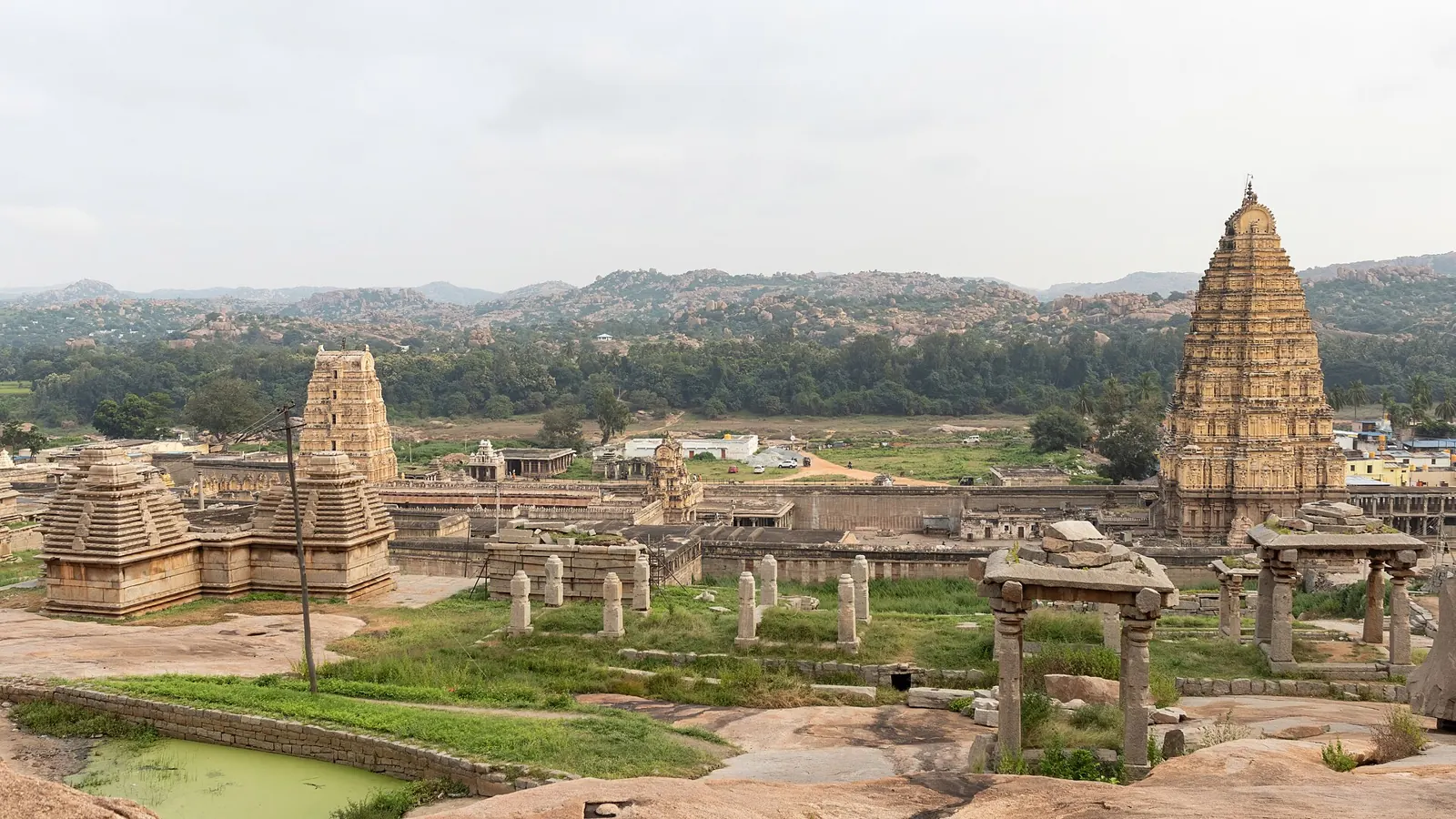
Hampi was the last capital of Vijayanagara, whose kings built Dravidian temples admired by travellers from the fourteenth to the sixteenth century. Robert Sewell (1900) records that Krishnadevaraya, early in his reign, built one gopura at the temple and repaired another, and made grants to it at his coronation festival.341
After the city was taken by the Deccan confederacy in 1565 it was plundered for six months and abandoned, but worship here continued. The temple is part of the UNESCO World Heritage Site inscribed in 1986.31
Architecture
The eastern gopura rises nine storeys, about 50 metres; inside, an inverted shadow of the tower falls on a wall. The complex also holds shrines of Bhuvaneshwari and Vidyaranya.21
Where sources differ
Karnataka Tourism dates the great eastern tower to the fifteenth century; the encyclopedia entry and Sewell associate the main tower work with Krishnadevaraya (reigned 1509–1529).214
Sources
- Encyclopedia Virupaksha Temple, Hampi — Wikipedia · accessed 2026-11-08
- Government Virupaksha Temple — Karnataka Tourism, Government of Karnataka · accessed 2026-11-08
- UNESCO Group of Monuments at Hampi — UNESCO World Heritage Centre · accessed 2026-11-08
- Book (1900) Robert Sewell, A Forgotten Empire (Vijayanagar): A Contribution to the History of India — Swan Sonnenschein, London, 1900 · Internet Archive · Reign of Krishna Deva Raya · accessed 2026-11-08
Researched 2026-11-08 from the cited sources. Community corrections are welcome; traditions differ, and differences are shown rather than resolved.